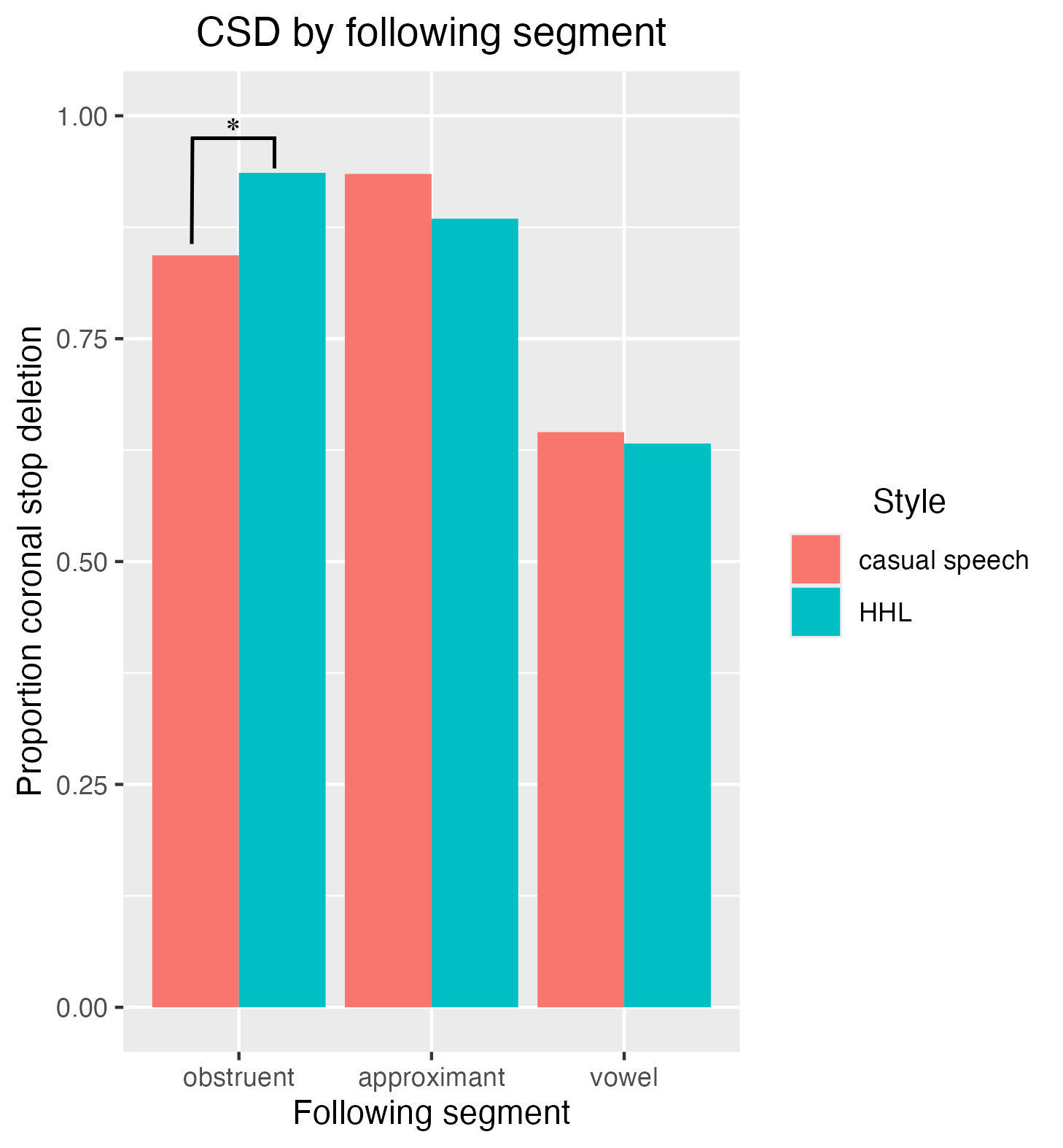
Hip-hop language (HHL) is a style of speech used in rap music and by those participating in hip-hop culture. Right now, we know a lot about how White men use HHL and about the the style’s syntax and lexicon. To expand our knowledge about HHL, and who’s represented in discussions of it, I’m focusing on the phonetic features of the rap and casual speech of rappers Megan Thee Stallion and Doechii, both Black women. Right now, I’m exploring how coronal stop deletion compares in the rappers’ HHL and casual speech, and intend to expand to other phonetic variables soon.
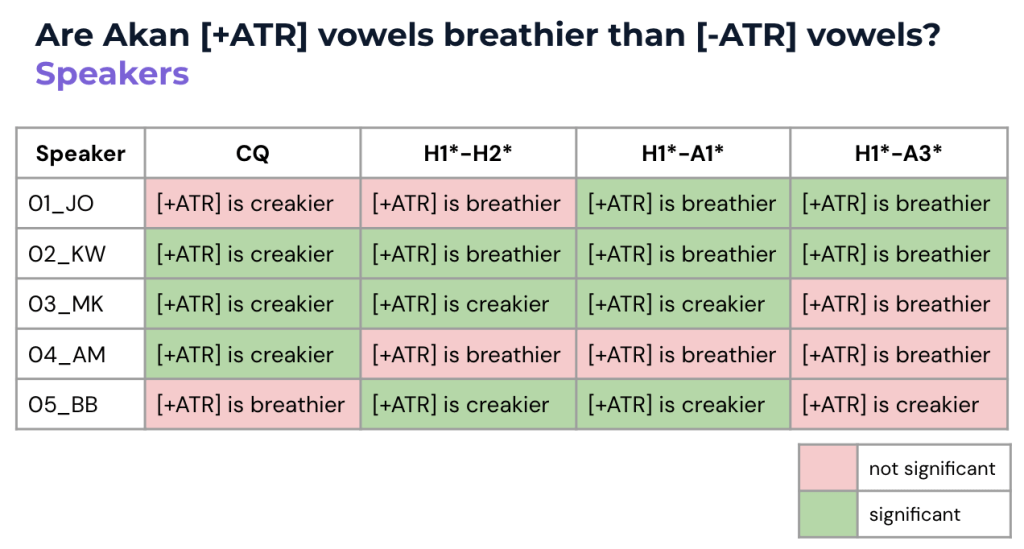
Research, on Akan and various other [ATR] harmony languages, often states that [+ATR] vowels are breathier than [-ATR] vowels. However, what exactly listeners are attuned to when making these descriptions is unclear. There have been a scattering of studies trying to find acoustic correlates of these descriptions, but findings have generally been quite mixed. In order to investigate this phenomenon in Akan, I measured vowel phonation in the language, collecting acoustic and electroglottographic recordings. So far, findings have been mixed, largely depending on the measure used to capture phonation. Mid vowels display some phonation differences, and individual speakers do too. In both cases, sometimes [+ATR] vowels come out as breathier than [-ATR] vowels and sometimes they come out as creakier. I intend to keep unpacking these results, and first plan to see if a composite measure can better predict Akan phonation.
 Rhosean Asmah